Imagine how well you might
have learned your way into life if you had grown up feeling
ashamed of your ability to learn.
According to the latest
NAEP scores(1) over 60% of
our K-12 school children are
below the proficiency level in reading. Their
reading skills arebelow the level necessary for the brain-work of reading to be transparent to the
brain-work of learning from what they are reading.
According to the latest
NAAL report(1), over 90 million adults are living lives
significantly constrained by their lack of reading proficiency.
The
individual,
social,
political, and
economic
implications are staggering. The
price tag is many hundreds of billions of dollars each year.
Learning to read isn't like like
learning a sport or a craft or a form of art or music. It’s not
an option in our schools or society. Day after day, week after
week, month after month there is no escape from reading. Not
only is it everywhere, but how well children read effects
how well they do in virtually every aspect of school which, in turn, profoundly effects
how they are maturing in general. For those who struggle with
reading the struggle is confusing, frustrating, and shaming.
Chronic confusion-frustration dulls the intellect. Chronic shame
eats away at
self-esteem. The lives of tens of millions of children and adults are
seriously-adversely affected. Beyond the obvious loss of opportunities in
school,
work, and
life, the insidious
collateral consequences that accompany learning to read difficulties are even
more painful.
Children who struggle with reading don't think
the cause of their struggle might be just a normal difference in their brain
analogous to being tall or short - they don't think that maybe their parents,
siblings, and other care-givers didn't engage them in enough complex dialogue
before they were four - they don't think that perhaps their teachers didn't
teach them correctly - they don't think their confusion is a consequence of an
archaic and artificially complex 'code'
that represents a completely unnatural processing challenge to
their brains... no, they blame themselves. "I'm dumb". "I'm
stupid". "I'm not smart". "I'm not good in school".
Some little ones may start off saying "reading is stupid" or
"reading isn't that important", but in the long run they can't
sustain such self-protective notions. Some kids later on may be able to say
"It's not my fault" - "I have LD", "I have dyslexia", "I have
ADD", but it is still about them - they still believe that whatever isn't working right
is in them - is them.
How often do you
engage in activities that make you feel ashamed of your mind -
ashamed of your ability to learn? Do you seek out such
activities or do you avoid them? Imagine what it must be like to grow up
believing that there is something wrong with your mind - to grow up feeling
ashamed of your mind. Imagine what your life would have been like if you
grew up emotionally averse to reading. How would that have affected your learning in general
and consequently your trajectory through school and later life?
Children who struggle to read experience the
struggle as a reflection of something wrong with themselves. Their
naturally intelligent tendency to avoid what causes them to feel ashamed
of themselves ends up motivating them to avoid learning. It is learning
disabling. Unintentionally parents, schools and society as a whole
contribute to perpetuating this insidiously learning disabling myth when in
fact, according to our nation's highest ranking education scientist, nothing
could be farther from the truth:
"The
shame has to be shifted.... There are some small number of children, who
because of biological problems, either specific to the underlying circuitry
for reading or general in terms of retardation and otherwise, who are going
to have difficulty in learning to read. But that’s a very small proportion
of the overall population. Reading failure for nearly every child is not
the child’s failure; it’s the failure of
policy makers, the failure of schools, the failure of teachers, the failure
of parents. We need to reconceptualize what it means to learn to read and
who’s responsible for its success if we’re going to deal with the problem.
Dr. Grover Whitehurst, Director Institute of Education
Sciences, Assistant Secretary of Education, U.S. Department
of Education
(COTC interview).
Why? Why are so many children and
adults experiencing reading difficulties and suffering such
life-harming consequences? What can we do?
While many in the country seem to engage in rhetoric, educational politics,
and superficial
debates about competing ideologies, methodologies and products, many if not
most of the 'experts'
closest to the problem think about it quite
differently:
The Children
of the Code Project is an effort to help provoke and resource a socially
widespread reconceptualization of the importance of reading and the challenges,
from the child's point of view, involved in learning to do it.
Though we
are very concerned with improving literacy levels we are even
more concerned with the impact of reading difficulties on the
‘health’ of our
children’s overall learning. Through hundreds of
hours of interviews and many hundreds more of research, we have
come to see prolonged learning to read difficulties as the root
of our nation’s most pervasive and expensive learning
disability. We've also become persuaded that Dr. Moats is right,
we as a society are busy debating
solutions to a problem that we don't sufficiently understand. The fact that
so many millions of children and adults blame and shame themselves for their reading difficulties is
just one symptom of how shallow that understanding is.
There have been many attempts
to promote and improve literacy.
Yet, after decades of literacy campaigns and reading wars there
isn’t much evidence of overall improvement. The lives of tens of millions of children and
adults are still being seriously-adversely affected by reading improficiency and its insidious collateral consequences. Part of the
reason for this is that the proponents of literacy and/or better
instruction tend to come with 'baggage'. Politics, ideologies, methodologies,
institutional funding needs, and marketing agendas all contribute to obscure the issues. They also tend to advocate "solutions" through the lens of
how to improve the 'teaching' of reading. While we are grateful for all who have
contributed to increasing social awareness of the importance of literacy, the Children of the Code
project comes
at it differently.
First of all rather than exploring reading through the lens
of teaching it, we explore reading through the lens of the challenges
experienced in learning it. Secondly, we have nothing to sell. We
don't advocate a particular methodology. We don't endorse any experts or gurus.
We are non-political. We are not a project of the government, a
university, a church, an institute, or a for profit corporation. Our allegiance is simply and strictly to the
health of our children's learning. Our basic
premise: regardless of ideologies or particular methods of instruction, the
better teachers and parents understand the challenges involved
in learning to read the better they can apply their preferred ideologies and
methods to helping children through those challenges. Thus, the
primary mission of our project is to help teachers, parents, and all
who care for children develop a deeper first-person
understanding of the "the code and the challenges involved in learning to read
it".
So far, we
have interviewed
over 110 leaders in the fields of neuroscience, cognitive
psychology, linguistics, orthography, instructional design,
child, adult, and family literacy, teaching, government policy,
and many other fields related to understanding the challenges
involved in learning to read. We have also interviewed over 40
struggling readers between the ages of 4 and 30.
Though our website will
include tens of hours of video, we are
editing the 'jewels' of our interviews into a series of
short stand-alone modules. Our intention is to provide a comprehensive learning
environment on our site that is made up of a modules
that can also be easily added to other outside web pages, slide-show
presentations, courseware, podware, and online media formats (see "Sharing the Videos").
We want to provide modules for parents who
need issue-specific resources to advocate for their child, for
college professors who want to develop more effective courses, for literacy organizations that need help fund raising,
and for
school board members or school superintendents who want to make the case for real change. We are also creating a number of
narrated/guided tours that we
will release closer to the end of the project. These tours, more
like traditional documentaries, will become TV broadcasts and
DVDs. One of the DVDs will be for parents, another for literacy
volunteers, and finally a more elaborate set for use in
professional development.
As part of our
overall support and dissemination strategy and in order to get
the kind of feedback we use to continually improve the
sequences, we frequently do live events. We delivered the keynote address to the Florida State Literacy
conference and presented our seminar at the American Library
Association’s Annual Pre-Conference. We have presented at over
40 live events including events on behalf of: numerous
state departments of education and special education, the
national conferences of organizations like the School Mental
Health Association and the National Center for Family Literacy,
community organizations, local school districts, and for some
corporations like Scientific Learning and Lindamood-Bell. Our
events weave Children of the Code sequences and multimedia
content into an exciting and perspective-shifting learning
experience. They are designed to help re-orient how teachers,
parents, literacy volunteers, counselors, justice workers and
the public in general thinks about the 'code and the challenge
of learning to read it.' Comments about our events from
attendees and professional development event organizers are
available at:
www.childrenofthecode.org/comments.htm For more
information, please see:
www.childrenofthecode.org/workshops/
Please share
the videos with everyone you think might benefit from them.
While all the video segments we produce will be available online on our
website, most of them will also be freely available as stand
alone modules that can be easily embedded and played within
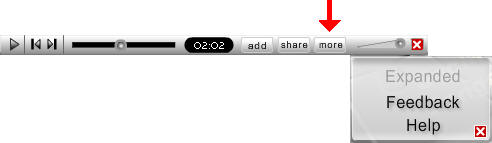
other non-profit educational websites. At anytime the
video player's toolbar allows viewers to simply and quickly
"add" the video playing to their own websites (again non-profit
educational sites only). The toolbar also allows viewers to
"share" a particular video sequence with their colleagues and
friends by simply entering email addresses and optional
comments. This results in the system generating and dispatching
messages that will enable the recipients to view the video in a
stand alone and optionally personalized format.
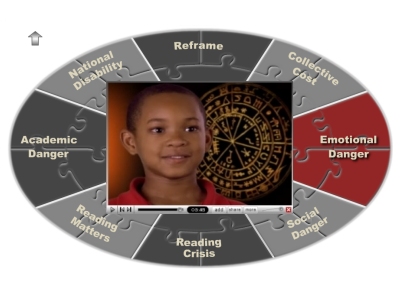
We anticipate two distinctly
different modes of using our online video resources. A
video navigator mode and an expanded mode. The video
navigator mode is for people who are primarily interested in viewing the videos.
Consequently, we have designed a navigation and presentation system that
showcases the videos, keeps the context of each video present, and allows for
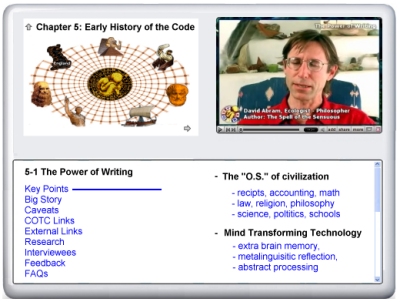
simple DVD-like navigation between the sequences. The expanded mode is for
students, researchers, and anyone interested in learning beyond the depths
possible in linear video. In this mode each video segment serves as an
orientation piece as well as a central organizing hub for accessing an array of
resources related to the issues raised and points made in the video. Currently
only the video navigator mode
is functional but we are
working on the expanded mode. Once
functional, learners will be able to move instantly between the
two modes while maintaining focus on anyone of the videos. The
video player's "more" button will provide the means for jumping
between modalities. In the expanded mode, each video will be
accompanied by other Children of the Code resources and by links
to other articles and research around the web.
It is very important to the long
range effectiveness of our project that we remain objective and
free from commercial, political, and ideological agendas. Again, we will not engage in the business
of selling or endorsing any particular methods or products.
However, there are many institutions, non-profit organizations,
and corporations who stand to benefit from our project. In order to keep our resources freely
available while also continuing our work to expand and improve
them we need financial contributions. Consequently, we will be
offering PBS-like still-image, animated, and video
acknowledgments of between 3 and 5 seconds that will play before
and after our videos do. Again, we will not endorse products or methods
but we will acknowledge with appreciation the support we receive
from companies and organizations who see the merit of our work.
We can use all
the help we can get. If you are interested in helping the project please take a moment to visit: (http://www.childrenofthecode.org/helpus.htm
) there you will find instructions and links that will assist you
in exploring the various ways that we might work together. After
you have explored the page and determined how and if you would
like to participate, please select among the available options
on that page and we will follow up with a response.
1) discount the NAEP and NAAL
data to whatever you think is reasonable and the dimensions of the problem are
still staggering.
2) in editing the sequences we
endeavor to be brief. However, the subject of each
sequence is worthy of a documentary. Many of the sequences will
have longer playing versions in the future.
Copyright
statement: Copyright (c) 2012, Learning Stewards,
A 501(c)(3) Non-Profit Organization,
All Rights
Reserved. Permission to use, copy, and distribute these materials
for not-for-profit educational purposes, without fee and without
a signed licensing agreement, is hereby granted, provided that "Children of
the Code -
www.childrenofthecode.org"
(with a functioning hyperlink when online) be cited as the source and appear in all
excerpts, copies, and distributions. Thank you.(back
to top)