An Interview...
Dr. Grover (Russ) Whitehurst – Evidence Based Education Science and the Challenge of Learning to Read
 Dr. Grover (Russ) Whitehurst was the Director of the Institute of Education Sciences, and an Assistant Secretary of Education with the U.S. Department of Education under the Bush administration (2002-2008). Dr. Whitehurst administered the Institute, including the activities of the National Center for Education Statistics, the National Center for Education Evaluation and Regional Assistance and the National Center for Education Research. During his service he advised the Secretary of Education on research, evaluation and statistics relevant to the work of the US Department of Education. He is currently a senior fellow with the Brookings Institution. Additional bio info
We found Dr. Whitehurst to be a person who genuinely cares for children and who is dedicated to fundamentally improving the quality of their learning in life.
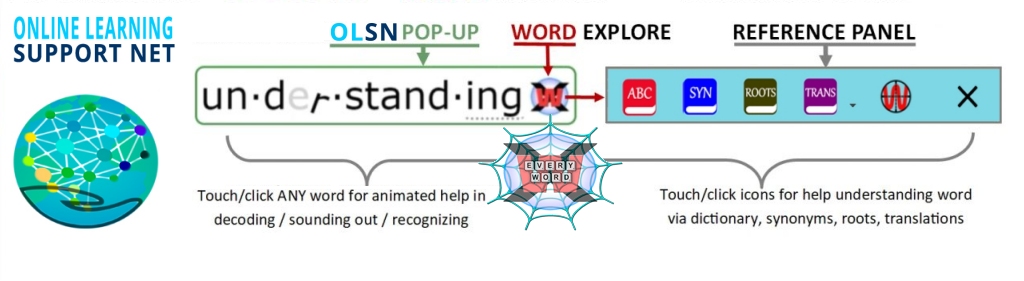 Note: Remember to click on any word on this page to experience the next evolutionary step in technology supported reading.
-----------------------------
David Boulton: Dr. Whitehurst thank you for being here. It’s a real honor to get to talk with you.
Dr. Grover (Russ) Whitehurst: Pleased to be here.
Personal Background :
David Boulton: Perhaps we could start with a brief sketch of you. You are the very first director of the Institute of Education Sciences; perhaps we could start with a sketch of yourself and the Institute.
Dr. Grover (Russ) Whitehurst: This Institute has a very, very important function to serve and that is to change the way that education is conducted in this country from a decision making process that is largely based on tradition or professional wisdom to a decision making process that is based on evidence. It’s our role to do two things: One is to collect the evidence that bears on important decisions, and the other is to encourage people to use it. That’s a daunting task, but one that I’m very pleased to take on.
My position prior to coming here was a researcher, and I spent most of my career trying to do research and collect evidence that would actually have an impact on how children are educated. I was often frustrated by the lack of a market for that information, for that research. So, it’s time for me to take some of the complaints I had about the way the government operated, both in terms of the research it conducted and the way it disseminated that research, and to take those criticisms and bring them to bear on the way we do this and have an organization that provides a greater type of customer service than was the case in the past.
David Boulton: So, your job description now answers the complaints that you had before in creating an opportunity to get some traction on bringing science rather than mysticism to driving education.
Dr. Grover (Russ) Whitehurst: Absolutely. I was known for making complaints on these dimensions. So, when I raised questions about why it was rational for me to come here and do this job one of the very effective retorts was, ‘As you’ve been saying, this is the sort of thing that needs to be done and now you’ve got the opportunity to do it, how could you refuse that request?’
David Boulton: So, you pinned yourself.
Dr. Grover (Russ) Whitehurst: I did.
The State of Reading in America’s Schools:
David Boulton: As you know, our series is about reading. It is our sense that our society as a whole is missing a sufficiently deep appreciation of the significance of reading. We’d like to start off with the state of reading in America’s schools.
Dr. Grover (Russ) Whitehurst: It’s a mixed picture. Students in America’s schools, in public schools at the top of the dimension in performance read as well or better than students any place else in the world. But we have a tremendous variation in student achievement in reading. As you know, we have from thirty-eight to forty percent of children not reading at the basic level at fourth grade. That means they are unable to deal with age appropriate written text and understand the text or make reasonable inferences from what they’ve read in the text. We know that children who have that sort of difficulty reading in fourth grade, without extraordinary help, are going to continue to have real difficulties down the road…it flows into other subject matters, the ability to finish school, the likely hood that they will drop out, they’re potential for life success, getting a good job.
So, while in some sense we’re doing well in reading and some of our students read very well, I think it’s simply intolerable that so many children have not got it by fourth grade and all of the negative consequences that flow from that really are a national crisis, something that has to be addressed by the federal government.
The Difference Between Basic and Proficient:
David Boulton: In addition to the two ‘book end’ categories, basic and advanced, there’s a middle category called proficiency. While there’s 38-40% in fourth grade that are below basic, the numbers go to sixty-eight percent that are below proficient. What is the difference between basic and proficiency?
Dr. Grover (Russ) Whitehurst: Someone who can read at the basic level can take age appropriate text, and the assessments that we use are generally assessments based on natural texts, the sort of books that children would be assigned in the classroom. Someone who is reading at the basic level can understand the words, can answer simple questions about the factual information presented in the written text and can read with enough fluency to get through the material on time and answer questions. Students who are performing at the proficient level can go beyond that to make reasonable inferences from the material they read.
So, if the written material was about a thief and the thief stole something, someone who is reading proficiently can make inferences about what that must have felt like for the person whose materials were stolen and what the thief might do next, or why the thief was engaging in thievery to begin with. They are able to comprehend a deeper sense of the written material.
David Boulton: So, instead of a kind of instrumental or more superficial basic level, proficiency is the level we would at minimum expect or ideally like to have of kids that can actually translate what they’re reading into some kind of more vibrant, real experience.
Dr. Grover (Russ) Whitehurst: Yes, yes. The National Assessment for Education Progress, which is the assessment device that we’re talking about here, defines proficient in that way. It comes at a definition of proficiency based on a national process of collecting input from teachers and reading specialists and others and deciding what should a fourth grader know to be considered to be proficient.
What you’ve just described, which is the ability to comprehend in some sense what’s read, to go beyond that and to use the material, is the underlying definition of what it means to be proficient.
David Boulton: So, if we think proficiency is important rather than basic, then the other side of basic is real trouble.
Dr. Grover (Russ) Whitehurst: Real trouble.
David Boulton: And on the other side of proficiency is advanced.
Dr. Grover (Russ) Whitehurst: Advanced, and that’s wonderful.
Are Most of Our Children Struggling?:
David Boulton: Yes, but that seems to suggest that most of our children to some degree are struggling learning to read.
Dr. Grover (Russ) Whitehurst: Most of our children are not struggling in terms of being able to break the code. It is the children below the basic level who, in large part, have not mastered code breaking. Where a lot of our children are struggling is being able to understand what they’ve read after they’ve broken the code and been able to sound it out. What do the words mean? That’s the challenge of proficiency.
But remember these thirty-eight percent, the children that represent thirty-eight percent of those assessed at the fourth grade level who are below the basic level, haven’t even broken the code. They haven’t mastered what would be expected at the end of first or second grade. So they have no chance of understanding; they are simply unable to read, in the fundamental sense, what they find on the page.
David Boulton: But without necessarily attributing causal relationship to code, we could still say that if sixty percent of our children, sixty-eight percent in the fourth grade, sixty percent in the twelfth grade, are below proficient that, whether it’s code related or comprehensional downstream, we’re still saying most of children are at some degree less than doing well at reading.
Dr. Grover (Russ) Whitehurst: They’re certainly performing below the level that this national consensus process has agreed is the definition of what it means to be reading appropriately at grade level.
David Boulton: Again, my question is, most of our children…
Dr. Grover (Russ) Whitehurst: Have a ways to go.
David Boulton: Are not doing well in reading?
Dr. Grover (Russ) Whitehurst: Most of our children could certainly be reading better than they are.
Code Processing Inefficiency Drags Comprehension:
David Boulton: Related to the difference between basic and proficient, as you’ve just described it, is that below basic is a fundamental inability to process the code and below proficient is a less than optimal ability to translate that code processing into comprehension.
So, ‘below proficiency’ represents this less than optimal comprehension of what has been decoded in processing. There’s a number of pieces of work that I’ve encountered that suggest that though people may have ‘broken the code’, the processing efficiency related to how they’ve learned to process the code is dragging down the cognitive processing resources resulting in this drag on comprehension.
Dr. Grover (Russ) Whitehurst: Yes.
David Boulton: So, the code, while breaking it we might say is a problem below the basic level, processing the code as a whole is central to this whole field (below basic through proficiency).
Dr. Grover (Russ) Whitehurst: Absolutely. Children who perform at the proficient level not only can understand the words that they’re reading and the paragraphs that they’re reading, in the sense of bringing to bear information from their own experience, other classes, reading, home and background to bear on what they’re reading; but they also read fluently. That means they’ve broken the code; they can turn letters into sounds at a level that doesn’t really require conscious processing anymore.
It’s like the child who has learned to ride a bicycle and really has learned to ride it. That child is not thinking about where her feet are on the pedals and how quickly she has to turn the pedals around and whether her hands are on the brake or not. That part of the process has been over learned and the child doesn’t even have to think about it anymore, and can now think about where the bicycle is going and why the trip is going to be taken and whether she should be going fast or slowly.
Children who have really broken the code have moved to fluency. The whole process of dealing with the code is now occupying a different section of the brain; it doesn’t require a lot of thought and allows them to go on and think about what they are exposed to, what they are reading, what’s written on the page and what it really means.
Breaking the Code and Developing Reflexes:
David Boulton: You say ‘broke the code’ as if there’s this digital state of either somebody’s broke the code or somebody hasn’t broke the code. But there’s evidence to suggest that it’s actually a large gray continuum. Certainly at one point there’s this alphabetic principle grasping, but between that and the automaticity, the transparency of processing we’re talking about, there’s a kind of ecology of processing efficiency that needs to develop… unconscious, faster than thought reflexes that make all of this flow together. Can you speak to that spectrum a bit, the difference between this and the digital on/off of whether they’ve broken the code?
Dr. Grover (Russ) Whitehurst: Well, at one end, as you’ve well articulated, are children who typically are still at the pre-school level or the kindergarten level, and breaking the code for these children means understanding the underlying principle that letters represent sounds. They may not know all the letters, they may not know all the sounds, and they certainly may not know all the links between letters and sounds, but the idea that these scribbles on a page are symbols that represent sounds is the beginning of breaking the code.
At the other end of breaking the code the whole process flows extremely fluently. The letters are over learned, the sounds are over learned, the connections between them are over learned and automatic, and it’s no longer necessary to think about it.
Between those two points requires a lot of practice. I think the distinction here is very similar to the distinction between the child who is taking his first piano lesson. The idea is that these piano notes written on the sheet music represent piano keys to be pushed, and the child eight years later who has not only taken piano lessons, but has practiced daily or weekly, who can play an etude and do it fluently and people actually enjoy listening.
That long process of practice, of use, of reading, of cracking the code, or in the case of piano playing, playing a lot of piano, that gets you to the point that that whole skill portion of it, the underlying skill base is taken care of. The piano player can think about interpretation and making it sound good, the reader can think about what it means. It’s a lengthy process; it’s a dimension that requires a lot of activity, a lot of practice.
David Boulton: So, that meta cognitive freedom from the drain of having to volitionally participate. One of the distinctions between piano playing and reading is that as I’m reading the note to cue my fingers, I don’t have to read seven more notes to figure out the note I just read.
Dr. Grover (Russ) Whitehurst: Well, I don’t agree. Being a terrible, but persistent pianist, I would not agree with what you’ve just asserted. Somebody who is a competent musician is, in fact, looking quite far ahead on the page.
David Boulton: Far ahead in advance of what they’re actually playing?
Dr. Grover (Russ) Whitehurst: In advance of the particular note that their finger is playing if it’s a piano. They are a measure or two ahead, just in terms of the time it takes to translate the notes on the page and the motoric action, they’ve got to be ahead.
David Boulton: Does it change the note?
Dr. Grover (Russ) Whitehurst: Yes. To the fluent musician how a particular note is played is very much a function of what came before and what’s coming next. Crescendo makes sense only in the context of how loud it’s ultimately going to be played and where you start it. So, there is a contextual nature for performing music that may not be identical to the contextual nature for reading but bears similarities.
David Boulton: Okay, good. I actually took this opportunity in our conversation to explore that and of course what I’m pointing to is the fact that the letters do not have distinct sound relationships, they are actually the center of a potential field of possible sounds. They are only resolved in context which requires this never-before-in-the-nature-of-the-human brain processing to disambiguate, rather than just “decode.”
Why Reading is so Important:
David Boulton: Why is reading so important to our children? We touched on this a moment ago, but I’d like to elaborate on this. There’s the developmental, both cognitive and emotional. What do we know from an education science point of view about the correspondence between how well children learn to read, and the infrastructure of their cognitive abilities and their emotional development?
Dr. Grover (Russ) Whitehurst: The functions of reading are many. At the fundamental level, the level I think everybody understands, reading is a critical academic task. It’s critical not only in the sense that Language Arts is a core component of the curriculum for elementary school children, but also in the sense that every area of the curriculum starting in elementary school depends on fluent reading.
Math is not simply a matter of doing addition or subtraction, but understanding word problems. You can’t understand word problems unless one can read. So, the skill components of reading, both in terms of being able to do the task of reading as it’s required by schools and doing all of the other subject matter that depends on reading, I think is obvious and straight forward.
In some sense some of the more interesting aspects of the functions of reading go beyond the obvious and have to do with the ability of children to think differently in a way that derives uniquely from written text. Writing is different in many cases from oral communication.
Oral communication depends very much on a shared understanding and background between the people having a conversation. You and I are having a conversation that shares certain assumptions about my part about what you know and don’t know, and your part about what I know and what I don’t know, much of which is communicated non-verbally.
Writing has a unique function of incorporating within the written text everything that one needs to know in order to understand the text and it generates a different way of thinking. Preliterate societies, even adults in those societies, don’t think in the way that people do in societies that are literate. And so the process of education, being an educated person in the Western tradition, I think, depends very much on being able to read and read fluently.
Another aspect is simply knowledge itself. So much of what children come to know cannot be learned directly. At the pre-school level there are children who are very familiar with what an elephant is, what an elephant does, who have never been around an elephant. They get that information from books. I can tell you something about atomic fission and atomic bombs and I’ve never been around one that I know about, but I picked up that information from books.
So, the frequency with which children read and the information they collect from that experience becomes very much a part of who they are in terms of the way they understand the world, their base of knowledge and the ability to think well. It’s all of those aspects of reading that are important.
Finally, there’s the aspect of reading for pleasure. To be able to be lost in a book, to enjoy that activity, to be able to engage in the empathy that comes out of literature and fiction is an experience that those of us who have been involved in it think of as one of the core aspects of living well. Individuals who are prevented from having that sort of experience because of lack of reading skills or reading fluency, I think, are missing out on a significant portion of what it means to enjoy life.
Reading and Cognitive Health and Development:
David Boulton: In support of some of the cognitive science pieces of this, reading is also this implicate cognitive exercise environment that, in addition to the possession of knowledge, is exercising the capacity for linguistic distinctions that are pretty much at the core of extending verbal intelligence. Would you agree with that or is there something you could say that would go into the cognitive ecology or cognitive health that comes from or gets exercised by reading?
Dr. Grover (Russ) Whitehurst: In some sense, reading and thought become the same thing. To think deeply about something in a way that is culturally valued often means to be able to articulate one’s thoughts in a structured, logical way. The experience of reading well, as well as reading widely, allows a person to do that.
David Boulton: So, the capacity for meta-cognitive analysis of what you’re thinking is enriched and exercised by the process of learning to read more richly and diversely.
Dr. Grover (Russ) Whitehurst: Absolutely.
Reading Skill Predicts Academic Success:
David Boulton: Relative to academic success, and you can speak to this however you feel comfortable with, we’ve heard some people like Anne Cunningham with the Society for the Scientific Study of Reading and others speak to the predictability of overall academic success being determined by reading efficacy in the first and second grade. That how fast somebody comes up into reading is a pretty accurate predictor of their entire academic success.
Dr. Grover (Russ) Whitehurst: It is. Knowledge of letters of the alphabet on entry into kindergarten is a very powerful predictor of reading success at the end of tenth grade. The predictive relationship is an unusually strong one for a span of eleven years in a child’s life.
Of course, knowledge of reading of letters of the alphabet is simply one measure of a child’s entry into the world of reading. If you look at the other end of the age dimension in terms of predictability, SAT scores, the verbal portion of the SAT which carries the greatest degree of prediction in terms of college success, the verbal portion of the SAT is a reading test. The SAT scores can be predicted from earlier measures of reading.
So it is, in addition to socio-economic status which largely is connected to the reading ability and cultural proficiency of one’s parents, probably the single strongest predictor of a child’s academic success.
Children’s Futures all but Fated by Reading:
David Boulton: What we’re getting as we start to explore the facets of this is that it seems as if our children’s futures are all but fated, not fated, but all but fated by how well they learn to read.
Dr. Grover (Russ) Whitehurst: Yes, that’s true. Particularly if we go back to the bookend analogy. Those children who are the caboose on the train, at the bookend on the left side of the books, are children who are at substantial academic risk.
Children who are failing at reading at the end of the first grade are extremely likely to be failing at reading at the end of fourth grade. And failure in reading strongly predicts failure in all other academic subjects. So, a child who is not breaking the code well, who has not figured it out, who is falling behind, is a child whose academic life course is at risk and because of that whose life is at risk because the economic opportunities of life.
Again, at the lower end of the dimension are ones that have profound effects on not only obvious things: quality of life dimensions, how much money one earns, or the neighborhood one lives in, but actually have effects on longevity, on how long you will live.
So, reading again, is absolutely fundamental. It’s almost trite to say that. But in our society, as it is structured, the inability to be fluent is to consign children to failure in school and to consign adults to the lowest strata of job and life opportunities.
Prison Cells and Reading Scores:
David Boulton: We were interviewing Lesley Morrow, the Past-President of the International Reading Association, and she made a statement which flabbergasted me. She said this was a fact: that there are some states that determine how many prison cells to build based on reading scores.
Dr. Grover (Russ) Whitehurst: Yes. Again, the predictability of reading for life success is so strong, that if you look at the proportion of middle schoolers who are not at the basic level, who are really behind in reading, it is a very strong predictor of problems with the law and the need for jails down the line.
Literacy for societies, literacy for states, literacy for individuals is a powerful determinate of success. The opposite of success is failure and clearly, being in jail is a sign of failure.
People who don’t read well have trouble earning a living. It becomes attractive to, in some cases the only alternative in terms of gaining funds, to violate the law and steal, to do things that get you in trouble. Few options in some cases other than to pursue that life. Of course reading opens doors.
The Cost of Our Nation’s Reading Difficulties:
David Boulton: Going on a broader, macro level – what does our population’s reading difficulties cost our nation? I’m not looking for precision, I’m looking for magnitudes of order. Economically, in terms of our global economic competition and in terms of the intelligence of our population and what that means about the security of our nation over the longer view.
Dr. Grover (Russ) Whitehurst: It is impossible to quantify the cost associated with reading failure or the advantages that flow to societies whose citizens are highly literate, who read well and read deeply and widely. It is clear, however, particularly in the context of a global economy, that increasingly the competitors of the United States, economic competitors, competitors in terms of ideas and philosophies, are competing in a way that undermines the ability of citizens in the United States to perform well based on the types of skills that involve lifting and pushing and using muscles. They are skills that depend increasingly on high levels of education. And even within high levels of education, the effects of global markets are that its only value added by special types of education, including high levels of literacy, that ultimately are going to allow us to compete well.
Software jobs that pay sixty dollars an hour in the United States are now done for six dollars an hour in India. For our citizens to compete, they have to bring to the software business a higher level of value. That value comes from the ability to conceptualize problems, to come up with novel solutions, to be creative, to think about how to market, speak to the world, speak to citizens of the United States, and all of those abilities flow from the understanding of a culture and oneself and other people that depends on reading.
David Boulton: So, as we said, reading is profoundly connected to this meta-linguistic verbal intelligence, and what makes us competitive is this innovative intelligence.
Dr. Grover (Russ) Whitehurst: Yes, absolutely. Innovative intelligence is a type of verbal intelligence. Verbal intelligence flows, depends on, and has a foundation in reading.
Hundreds of Billions of Dollars:
David Boulton: Back to being more specific on the economic implications. I’ve heard ninety million adults are not reading above the fifth grade level and are losing a couple hundred billion dollars a year in potential income, as it’s projected by literacy organizations, because they can’t read. I’ve heard there’s ten to fifteen billion dollars in research and federal spending and literacy program expenses. As you said before, it’s hard to get a handle on. But even in the roughest possible terms, what could we say the economic drag of this reading problem is in some kind of numbers?
Dr. Grover (Russ) Whitehurst: At the federal level, the U.S. Department of Education, a substantial portion of the Department’s discretionary budget, which is roughly fifty-three billion dollars a year, is spent on problems that are related to reading.
Title I, which is our single largest grant program, which is a grant program for schools that serve children from low income backgrounds, is a grant program that is focused primarily on the problems of low academic achievement, and reading is at the core of academic achievement.
One could look into other areas of the department’s budget such as drop-out prevention or safe and drug-free schools, and find that these problems are correlated in the current circumstances in which there are large populations of kids who are not being served well by the schools, who are not doing well academically.
So, simply at the federal level, the cost of supporting academic achievement and reading is substantial. The federal budget is only about eight percent of the national expenditure on K-12 education. And so, if one imagines that simply in terms of elementary and secondary education, states and localities are spending in like kind for issues related to reading, then the cost just in terms of primary education becomes substantial.
What goes into law enforcement issues and jails, all the rest, under-employment, unemployment insurance, the need to support women and children who are not employed – all of these issues are connected to literacy and education. Presumably the cost for these programs would go down substantially in concert with increasing levels of literacy and education attainment.
David Boulton: So, just in terms of magnitudes of order, not even counting the lost opportunity cost dimensions of adults who are not reading well, we’re talking about hundreds of billions of dollars.
Dr. Grover (Russ) Whitehurst: Yes, absolutely. No question that the price tag is hundreds of billions of dollars; both to support the normal acquisition of reading and certainly to deal with the consequences of reading failure.
We know that the earning potential of a college graduate is over twice that of a high school graduate –
connected to reading ability. We know that students who finish high school and have only a high school degree, but get the high school degree as a regular degree rather than an equivalency degree, earn at substantially higher levels. And so again, that’s connected often with reading: reading success and reading failure.
So, it’s hard to find a problem that’s not connected to reading. Certainly under employment and employment at low levels of wages is very frequently a reading problem.
I had a conversation with an individual within the last year who runs a business, a large chain of garages, and who now, in recruiting mechanics, checks their reading scores and their math scores before employing an entry level mechanic. Even in trades that have traditionally been manual trades or trades that are craft trades, the requirements of literacy, both numeric literacy and reading literacy, have increased to a level where the inability to perform or the ability to perform depends on literacy levels that weren’t previously required and places new demands on our education system.
One thing I think worth considering is that it’s a moving target. The literacy requirements for proficiency, cultural proficiency, fifty years ago were substantially lower than the literacy requirements for proficiency in the twenty-firstt century. And we’re going to find because of global competition that we’re going to have to read better at higher levels, and the overall efficiency and efficacy of our education system for reading is going to have to continue to improve. We can’t rest on success defined in 1950 terms, it won’t get the job done.
Psychological Development:
David Boulton: There’s another consequence to all of this. We’ve been talking about dollars, we’ve been talking about academic success, we’ve been talking about economics, jobs, national intelligence and so forth. But reading, if it works great, we can say is this fundamental, necessary, but insufficient thereafter, instrumental skill. We’ve got to do it. But for those who don’t, the consequences go far beyond just the economic and academic difficulties, as powerful as they are. There are psychological-emotional-developmental issues. What can you say to that?
Dr. Grover (Russ) Whitehurst: The ability to be self-aware and self-reflective is a double-edged sword. The ability to think about what you’re doing and think about what other people are doing and conceptualize what that means for you personally or for your family members is very much a product of literacy and the ability to read. The capacity to manage oneself, to deal with personal problems, to think in terms of long term consequences of one’s actions rather than in terms of short term consequences. Rather than doing this thing today that’s a lot of fun, I will do this other thing because a week from now I’ll be better off. The ability to delay gratification, work hard, depends on thinking abilities, cognitive abilities that are connected with literacy.
So, there’s much here that is outside of the formal understanding of print that has to do with the ability to act in ways that are self-fulfilling and that manage one’s own resources successfully, both in the positive end in terms of planning, as well as dealing with stresses and vicissitudes of life.
If you can think it through, if you can read a book and find out that somebody else has gone through these problems and think about how to apply these experiences at a distance from one’s own circumstance, you can handle things better. I think that is important to the psychological development of children and for the ability of our nation in terms of its citizenry to think about what it’s doing and makes decisions at a ballot box, for example, that are based on reasonable projections of long term self-interest rather than the emotional vicissitudes at the moment.
Shame:
David Boulton: The work of the National Institute of Child Health and Human Development, in summarizing the reading research, seems to indicate that while there’s many different problems, there’s a spectrum of related problems involved here and that one of the first consequences, almost across the board to children who struggle with learning to read, is that they feel ashamed of themselves. They feel as if there is something wrong with them.
Dr. Grover (Russ) Whitehurst: Part of the complex of reading failure is increasing frustration by individuals, children who are failing to read at their success in school and what school is all about. It can in some cases, in desirable cases, resolve in greater motivation to try to get help and succeed. But in many cases it generates a sense on the child’s part of helplessness; helplessness not only with reading, but helplessness with school. You find those children turning to other avenues to gain reward to gain self satisfaction.
So, they don’t read well, so they don’t read. They may play a computer game because they’re better at that. So, you find individuals shifting their activities into areas which they are getting a sense of satisfaction, a sense of reward, and away from activities that are frustrating, and that’s certainly the case for reading.
You see a pathway taken for children who are failing to read and it’s a way of preserving their self-concept of succeeding, but it’s a pathway that is not ultimately to their benefit because it takes them away from the activities from which they can derive knowledge and develop the skills that are important for success in school and in life.
David Boulton: At a somewhat more implicate level the emerging emotional sciences, with respect to ‘affect’ and its driving and directing influence over cognition, have suggested that we operate in a way that once shame gets to a certain threshold level we want to move away from it. The National Institute of Child Health and Human Development research studies are saying that children, because of the way we contextualize this whole reading experience, are feeling that there is something wrong with them because they can’t do this.
Again, we’re back to our beginning points: most of our children are to some degree in this space, for some degree of their education, feeling ashamed of how they’re learning. And if shame causes us to want to move away from what causes shame, then we want to move away from learning.
Dr. Grover (Russ) Whitehurst: Yes, that’s certainly true. And we need solutions to this. We need curriculum solutions so that fewer children experience frustration and difficulty during the task of learning to read. We need to change the context of schooling so that the child who’s struggling in reading in third grade can have that problem addressed in a way that isn’t stigmatizing to the child and doesn’t generate the sense of shame. We need in some way to break out of the lock-step nature of elementary education so that if you don’t have what the other children have in first grade for some reason you are forever doomed and will never get the opportunities to pick up that information.
It is a very significant problem and the emotional and social consequences of reading failure are extremely important and are the soquali of the bad experiences that come from sitting down with text and not being able to figure out what’s going on, or not being able to figure out what’s going on at the level of one’s peers.
It’s often the implicit comparison with what other kids are doing in the classroom that generates not only the shame, but in some cases, the lack of motivation to do better. That is, if the overall expectations for that classroom, those children are low, then there’s no shame on anyone’s part with reading failure or low level reading success. The teacher isn’t ashamed, the school district isn’t ashamed and the state isn’t ashamed.
We need to create a context in which people understand that there is a problem, that they need to deal with it, but the child doesn’t experience shame for having not benefited from the type of instruction or societal support necessary.
Shame Disrupts Cognition:
David Boulton: Right and that shame isn’t just a ‘we don’t want to have it’ feeling. It is fundamentally, to processing, cognitively disruptive. If somebody starts to associate shame with the process of learning to read, they have just made it a magnitude of order more difficult to learn.
Dr. Grover (Russ) Whitehurst: Absolutely.
David Boulton: This is something, that in our travels, very few people understand.
Dr. Grover (Russ) Whitehurst: Well, I would say that in general, educational pedagogy, educational curriculum have not paid much attention to the psychological dimensions of learning beyond the cognitive dimensions.
As one can come up with a sequence of material expectations for what children should learn and how they should learn it, and to the degree that those materials are well designed and the sequence is well designed, that’s an extremely important first step. But how to deal with errors, how to deal with failure along the way, how to maintain motivation to perform is an issue that we’ve paid less attention to than we should have, and that results in significant numbers of children who are turned off from the educational experience when it was entirely unnecessary that that be the outcome.
Is Education Pervasively Backwards?:
David Boulton: My next big question is why do we have such reading difficulties? But before we go there, there’s an even bigger question than this entire series, and this intersection we’re at pegs it for me. And that is, that it seems that our education system, almost as an entire carrier wave or orientation, proceeds from the assumption that what we have to teach at any given second of interaction with the child is fundamentally more important than the quality of their participation from the inside-out in their learning. It just seems pervasively backwards.
Dr. Grover (Russ) Whitehurst: Well, I don’t know that that’s generally the case, but I do know, and I’m being repetitive now, that there’s been insufficient attention paid to the interactive nature of teaching and learning. In a sense, that if the teaching materials are designed well, learning will follow from that.
But children are uniquely varied, they’re highly variable and each child is unique. We need a system that pays attention not only to the materials as presented, but to the child’s response, and that is fine tuned in that sense.
When you look at mother-infant interaction you see a very fine tuned dance. The infant will do something and the mother will respond and the infant will respond to the mother, it’s a uniquely social sort of exchange. When teaching is done well, (and it can be by software by the way; it’s not necessarily a human interaction we’re talking about), when the interaction itself is ideal, you find that fine tuning between the materials as presented, the learner’s response, the next series of responses, the materials, the overall sense of praise and reward for what’s going on and everybody is engaged. You can have excellent materials but a lack of engagement because of insufficient attention because of the learner half of the equation, what the child is bringing to the interaction.
David Boulton: Ultimately, learning is an inside-out participatory process for each child. It’s very different from dragging them through a series of buckets of experience…
Dr. Grover (Russ) Whitehurst: It is certainly the case that learning ultimately resides in the child’s brain and that learning in any circumstance is the joint function of the materials as they’re presented, as well as what the learner brings to that situation.
Again, there needs to be a tuning, an alignment of the instruction materials and the interaction with what the child is bringing to the situation, not only in terms of cognitive background and assumptions, but also motivational background as well.
Stewarding the Health of Our Children’s Learning:
David Boulton: Is there an educational mission that trumps, that is more important than stewarding the health of our children’s learning?
Dr. Grover (Russ) Whitehurst: No, when put that way. Nothing is more important as an educational mission than paying attention to the overall nature of the learning experience for children and what they get out of the education system as they encounter it from pre-K all the way though post secondary education. We understand well that there are particular skills that have to be required as a function of that educational experience. But there are also a set of dispositions and attitudes and approaches that come out of a good educational experience as well. Ultimately, it is those dispositions, attitudes and approaches that drive learning down the road and that prepare adults for the changes that will occur over their life times and what they’re expected to know and what they’re expected to be able to do.
The sense that ‘There’s a new task here, I can learn something about how to do it from reading about it. I can challenge, I can be challenged by this, I can acquire new information and it’s worthwhile to do that’ is I think a legitimate and important product of an educational experience. We need to pay attention to that as well as the particular skills that are derived from the day to day teaching interactions that are part of the curriculum.
David Boulton: There’s no question that we can say we need to be able to read.
Dr. Grover (Russ) Whitehurst: Yes.
David Boulton: We need to be able to manipulate math.
Dr. Grover (Russ) Whitehurst: Yes.
David Boulton: We’ll come to the differences between those two different code processes in our next segment. But it is very difficult to predict at this time what today’s kindergartener needs to ‘know’ fifteen to twenty years from now. What it seems that we can say is that how well they’re able to learn in situations we can not predict is actually beyond certain basic skills, and the ability to interface with the world so as to pull what they need to learn as they’re needing to learn it, is what is most important. That, any other things that we impose on them are to impress our values, not necessarily to develop our children for their future.
Dr. Grover (Russ) Whitehurst: Yes, but as attractive as what you just articulated is, there’s a danger, however, in designing an educational system where the goals are articulated as non-specific and learning to learn and dispositions to learning. It is not quite clear how you get from here to there. It may well be that if our education system focuses on the basic skills and abilities that our culture has defined as important, cultural information to be transmitted by schools and does a good job at that, that perhaps not by design, but as a necessary consequence, children may pick up not only the dispositions, but the approaches to learning that will serve them well when new tasks arise that could not have been predicted in the first place, and therefore, could not have been designed in the system.
David Boulton: It certainly cannot be done in a vacuum. We’ve got to have something that is the exercise environment and it might as well be what we think is most important.
Dr. Grover (Russ) Whitehurst: Sure.
David Boulton: No question. But the quality of their participation is more relevant to the future of their ability to learn than a particular content they’re exercising with at the moment.
Dr. Grover (Russ) Whitehurst: Perhaps, though I would argue that there are certain basic skills and certainly reading is one, math is another…
David Boulton: Yes, beyond that, the other side of reading and math and basic skills…
Dr. Grover (Russ) Whitehurst: Sure. Engagement is a very powerful variable and when it’s absent…
David Boulton: Then we’re teaching the children that being dull and not participative is…
Dr. Grover (Russ) Whitehurst: Well, and probably when we have situations in which students seem to be learning well, seem to be doing well in measures of outcome, but are obviously not engaged. You can look at them in the classroom, you can ask them and find out they are not engaged in the process. In most of those cases I would assume and hypothesize and guess that there is something wrong with the assessment. It is very difficult over a long term period, considering the school year a long term period, to get children to learn what they really need to learn if they are not engaged. So, it may be that the assessment system focuses on the wrong thing or skills at such a low level that you could show progress in the absence of engagement. But if you are measuring legitimately the authentic outcomes of the learning experience as it’s designed it is probably difficult to get good performance absent engagement.
David Boulton: There’s a difference between the depth of the general transfer of learning and the temporary associative remembrance of what it is that we may be assessing. Thank you for that track off into learning in general. That’s actually our greatest interest. The reason that we’re on reading is that it seems to be the fulcrum at the center of freeing learning in a way. ‘Stewarding the health of children’s learning as if how well they’re participating is the guiding light in which to exercise the content that we think is important and relevant and the skills they’re learning’, that’s the place that we come from in the work we are doing.
Dr. Grover (Russ) Whitehurst: Yes.
Why is Reading so Difficult?:
David Boulton: So, let’s go back to why is reading so difficult? We’ve been doing this for hundreds of years.
Dr. Grover (Russ) Whitehurst: Reading is difficult for several reasons. One is that it’s a code and the code is not transparent. The relationship between letters and sounds is not necessarily natural and in the English language the code is made extraordinarily difficult by exceptions and rules and rules that are exceptions to rules. And so even when you’ve learned the code, you can end up not knowing how to pronounce something, not knowing how to sound something. So to begin with, we’ve got a difficult code.
A second problem is that our brains are really not really set up to deal with this code. It is not language. We have evolved a neural system to deal with the processing of language over the course of the evolution of the human species. Writing is a late invention and our brains deal with difficulty with the issue of processing all of this information quickly, assembling it so that one can understand what one reads. We know there are children with reading disabilities for whom the wiring is not there particularly in terms of processing sounds quickly and it generates difficulty for reading.
Third problem is instructional confusion. So, we have a difficult code, we have a neural system that for some children is not optimal for dealing with this code, and then we throw them an instructional system, a teaching system; teachers who don’t understand what the code really is or how it needs to be conveyed. And so the teacher is suggesting you should do this when in fact the child should be doing that.
You can sample first or second grade classrooms around the country and you will still find, despite what we know about the process of reading and have learned over the past twenty years, you will still find that teachers for a first grader who is struggling to sound out a word who will discourage the child from doing that, and encourage the child to look at the pictures in the book and guess what that word means. Good readers don’t guess, good readers sound out almost every word on the page. So, the teacher is saying you solve the task this way when in fact the task has to be solved in an entirely different way. That can not help but confuse children. So, non-optimal instruction, and in some cases simply misleading instruction, is a significant part of the problem.
David Boulton: I am just amazed at the lack of general appreciation, aside from the significance of this, one, and two, the total lack of understanding of what the nature of this challenge is to the human brain and trying to move through it into fluency.
Dr. Grover (Russ) Whitehurst: Well, there remains a very clear and present problem. Getting people who are involved in the teaching of reading and generating state, local and national policies with respect to reading to pay attention to what the evidence says. Education in all its forms is not a field that has paid much attention to evidence.
So, you will find somebody looking at a piece of medical research and they might quarrel with how those findings can be generalized. ‘Oh well, the research says hormone replacement therapy doesn’t in general work. Well, I had some success with it, I’ll talk to my physician about it.’ But in reading that’s frequently not the case. You’ll expose people to research and they’ll say, ‘Yes, I see it, but I believe….’ The ‘I believe’ is taken as being equivalent on the scale with the evidence. Again, going back to our first conversation, one of the things that it’s my job to change.
The Role of Science:
David Boulton: As we were talking about a little while ago, in terms of the challenges of reading – we talked about the code, we talked about the instructional problems, we previously talked about the different consequences and difficulties. We were just going into pedagogy. How is it that we teach children to read in some more optimally effective way and what is the role of cognitive science, emotional science, code science and neuroscience in helping us understand how to unfold this radically unnatural confusion to the human brain so it can grow through it into fluency?
Dr. Grover (Russ) Whitehurst: Well, the role of the underlying basic sciences in helping us solve the challenge of reading success for all children is substantial and fundamental. What we’ve learned from the NICHD research investment over the last twenty years has been fundamental to policy changes in terms of reading instruction in this country. The No Child Left Behind Act and Reading First have incorporated in them, to an unusual degree, scientific findings in terms of what is required of grantees who receive federal money and then spend it for reading instruction.
So, the contribution of current and historical cognitive neuroscience and the next generation of that science is going to be extremely important. At the same time, I believe we know enough now to do a dramatically better job in educating our children in reading and related skills and abilities. We know enough now to do a substantially better job at that. There are engineering tasks at hand that have to be attended to, and if we attend to those tasks the overall level of reading performance is going to soar.
There are going to continue to be substantial numbers of children who will not read optimally, who don’t respond as well as one would hope to these newly engineered delivery mechanisms. I think it’s the next generation of cognitive neuroscience that is going to allow us to identify early on who these children are and the special sort of help they may need to get through the process of learning to read.
But for somewhere in the neighborhood of eighty-five to ninety percent of children in America, this is not a figure grounded in specific statistical studies – it is a guestimate on my part, for the vast majority of children who are reading less well than they could, the problem facing us is to take the knowledge we currently have and see that it is engineered into teaching materials, curriculum, teacher training and professional development in such a way that we can benefit from all that knowledge in terms of what we actually deliver on the ground in classrooms to kids.
Reading is Code Processing:
David Boulton: Let’s talk about that science for a moment. Between the time that our eyes scan a letter and this code driven thought tracks through our mind, whether we virtually hear it or we actually speak it, a series of processing layers are involved in assembling and projecting this stream we call reading. When we break that down, all of this has to happen, this conversion of letters into this stream, faster than we can possibly think about it. If we’re thinking about it, we’re stuttered up.
Dr. Grover (Russ) Whitehurst: Yes.
David Boulton: It has to happen faster than we can think about. So our brains have to learn in a way that there is no evolutionary precedent for; the brain never had to do anything like this before. It has to take these code elements, which are inherently ambiguous, and hold onto them and work out the ambiguity sufficient to create this stream faster than we can think about and fast enough to simulate oral speech as we hear it and say it so that it is comprehendible to us. Later we transcend that, but in the beginning stages we have to go through that.
When we look at that in terms of where the timing bogs are, like Tallal’s circuit work, we bring in some of the different dimensions. It certainly seems that what we have is a disambiguation processing overhead timing problem.
Dr. Grover (Russ) Whitehurst: Sure.
Unnatural Disambiguation:
David Boulton: Which what we’re saying then, if we step back, most of our children are having their lives all but fated socially, academically, economically, because their brains can’t process the ambiguity out of this man-made, invented code fast enough to simulate this natural speech circuitry and they’re feeling like there’s something wrong with them because they can’t.
Dr. Grover (Russ) Whitehurst: Yes, that’s a very significant problem. The problem is not only disambiguating the letter-sound relationships, they are very much contextualized, but there’s significant overhead associated with disambiguating the meaning of the words. That process involves assembling and holding in memory not only information that came from outside of the written text, but information in the prior sentences and paragraphs that have been read. You find these two problems coming together and creating special difficulty for kids.
If I said to you Bill Gates bought the New York Times this morning, that would generate, I expect, a very different response than if I told you I bought the New York Times this morning. The only reason that those two sentences have a fundamentally different interpretation for you is that you know Bill Gates is the richest man in the world and could have bought the New York Times Institution, whereas, I’m a federal civil servant and may have been able to afford the paper at the news stand.
Children who don’t have the underlying knowledge of vocabulary or cultural background have to not only make sense of the code, but also make sense of the words. Their lack of certainty about what the words mean gets in the way of their sense of assurance that the code has been cracked. So, these two problems support each other and together contribute to the child’s sense that something is wrong here.
So, you need not only the code breaking exercises and all the practice that involves becoming fluent with that, but the experience with oral language and understanding what words mean in the conversations one has with other educated people and parents and teachers to be able to collect the knowledge of words and their meaning and understanding of the way the world works to disambiguate those aspects of the printed text as well.
David Boulton: Yes, and as we were speaking before, frequently I can’t know a word’s meaning until I can virtually pronounce it or actually pronounce it, and I can’t virtually or actually pronounce it until I’ve read a word or two down the road.
Dr. Grover (Russ) Whitehurst: That’s right.
David Boulton: This is a stretch into buffer processing that’s never happened before.
An Astounding Neurological Achievement:
Dr. Grover (Russ) Whitehurst: It’s an astounding neurological achievement to be able to process all of that information, to simultaneously consider multiple sources of information, both code related, phonological and semantic, and to keep all that in memory and produce something that’s understandable to oneself or somebody else.
Extraordinarily Difficult:
Dr. Grover (Russ) Whitehurst: One of the experiences that can bring home what we’re talking about here is to look at a child who’s struggling with reading. Try to read a passage in a book. Reading that for a fluent reader would involve sixty or seventy words a minute. I have video tapes back from my prior life as a researcher where we have first graders who are taking seven or eight minutes to get through a short, age appropriate paragraph. By the time they get to end of that paragraph, struggling to sound out the words, with parents help, I can’t remember what the child said ten minutes ago, much less the child who is struggling with all the consequences of reading failure.
It’s like any skill, once you’ve acquired it it seems easy, it seems natural. I think parents, teachers and children don’t appreciate how extraordinarily difficult this is. And how if the bar of expectations for what you’re supposed to be doing is way in advance of what you are actually able to do, then the emotional consequences, the frustration feeds into the process. So, you have an explosive mixture of delays in the development of phonologically related skills, delays in the development of semantic knowledge and background knowledge and a contrast between what everybody knows you’re supposed to be able to do and what you are actually able to do. That interferes with the process, as well as a performance problem that often leaves children showing that they’re able to do less than they’re actually able to do because the frustration and emotions, the demands of the task interfere with the child expressing what she’s actually able to do if she relaxed and wasn’t concerned about performance.
The Downward Spiral of Shame:
David Boulton: In one part of the series we call it the ‘Downward Spiral of Shame.’
Dr. Grover (Russ) Whitehurst: Yes.
David Boulton: The moment that somebody starts to feel uncomfortable, there’s this split in the processing bandwidth necessary to do the task. The more that they can’t do the task the more that they feel uncomfortable and the more they feel uncomfortable the less they can do the task and down and down and down.
Dr. Grover (Russ) Whitehurst: Sure. At the code level, the task is one that requires practice, there’s no short cut for it, and so another consequence of this is that children who are struggling don’t read; they’ll read when they’re required to read, when someone’s looking over their shoulder, but they will not read for pleasure. There end up being vast differences in the exposure to the written language that are a function of underlying skills. The underlying skill effects motivation and the motivation effects reading for pleasure. Reading for pleasure is a source of the information that prepares you to deal with the next level of reading. So, it is a cycle of failure or success that feeds on itself.
David Boulton: We have the ‘Downward Spiral of Shame’ and the ‘Matthew Effect.’
Dr. Grover (Russ) Whitehurst: Exactly so. And reading is actually unusual in that respect. Statistically we tend to find in other areas of development something called regression to the mean. That means that children who score the lowest on whatever assessment is being given tend to score higher next time. Likewise, at the upper end you find some regression towards average performance among those children who scored extraordinarily well. So, you get kind of an ad mixture over time. With reading it’s very different, the paths are diverging. That’s why it’s so important from an education perspective to identify the problems early and a preventive approach rather than the approach that depends on the occurrence of failure and the attempt to remediate that failure.
David Boulton: Too late.
Dr. Grover (Russ) Whitehurst: Well, it’s not too late, but it’s extraordinarily difficult. It’s certainly expensive.
David Boulton: It’s too late in the sense that we’ve passed the point of optimal intervention.
Dr. Grover (Russ) Whitehurst: That’s right.
David Boulton: Not that it’s too late in a dooming sense.
Reducing the Shame:
David Boulton: One of the main missions of this series is to help parents and teachers reframe the lenses they’re looking through as they observe a child learning to read. As we talk with parents and teachers it’s amazing how few of them recognize that this is an artificial, unnatural, technological interface issue. Most think it’s a natural thing to do and there must be something wrong with the child. Even most of our researchers call it deficits as if we’re talking about some inadequacy in the nature of the child, which is boggling. How can we ever get past this shame-inducing context unless we reframe this so that we see that most children do struggle and we treat them as if “It’s okay if you struggle. This is not a natural thing, no animal has ever done it, and very few humans have ever done it.”
Dr. Grover (Russ) Whitehurst: Well, the shame has to be shifted. The context of the shame can not be the child’s performance. It is those of us who are responsible for teaching children to read who should be ashamed if we fail to succeed at that task. There are some small number of children, who because of biological problems, either specific to the underlying circuitry for reading or general in terms of retardation and otherwise, who are going to have difficulty in learning to read. But that’s a very small proportion of the overall population. Reading failure for nearly every child is not the child’s failure; it’s the failure of policy makers, the failure of schools, the failure of teachers, the failure of parents. We need to reconceptualize what it means to learn to read and who’s responsible for its success if we’re going to deal with the problem.
Unfolding via Sync vs Systematic Instruction:
David Boulton: One of the things that we’re finding traction with, that I’d like to share with you just to get your response about, is that rather than having some model mediate your sense of working with the child – I’m supposed to do phonics, whole language or integrate these different systems (which by the way, as I’m sure you are aware, are all compensations for the mess in this code) we encourage people to get a first-person experience of the correspondence between the articulation stutters in the developing reader and the ambiguity they’re processing; to get to sync with them there so that you have a ground reference for working them through these different layers of ambiguity, rather than throwing some system that you’re imposing upon them.
Dr. Grover (Russ) Whitehurst: Well, maybe. On the other hand, if implied by your comment is that every child will receive an individualized instructional package delivered by…
David Boulton: We’re talking about parents for example, that can actually deal with this.
Dr. Grover (Russ) Whitehurst: Well, it could be, but then for parents to deliver such an experience requires the parent to well understand what needs to be transmitted and to have a level of skill and understanding that probably is unrealistic. If we shift back to the classroom, the model of the gifted and well trained teacher who can individualize instruction for every child, including reading instruction, may be unrealistic. It’s arguable, and certainly in my position, that well designed instructional materials, by well designed I mean taking into account what we know about the code and how difficult it is, how to make it simpler and more transparent in particular stages in learning to read, well designed instructional materials, teachers who know how to support children as they are exposed to those instructional materials and periodic assessments so we know when children are falling behind. Standard packages of materials as preventive strategies may be sufficient to move us substantially ahead in terms of solving this problem. It will not get us the whole way, but it’s going to get us, I think, a long way there. One of the principle problems here is instructional confusion. If we can reduce that confusion we’re going to generate more successes in learning to read.
David Boulton: From your vantage of trying to find the fulcrum to lift the population and needing to do it through statistically probable approaches, there’s no question we have to do that.
Dr. Grover (Russ) Whitehurst: Yes.
David Boulton: Putting that aside, clearly, compared to being in sync with the flow of confusion the child is actually experiencing and meeting them in that confusion so as to help them through it, everything else is a statistical approximation.
Software:
Dr. Grover (Russ) Whitehurst: That would be the ideal pedagogical approach, instruction materials finely tuned to an individual child and that child’s progress through the task to be solved. My own view is that software is eventually going to get us there for reading. And other areas of instruction where at least for some children you need the acutely fine tuned personalized instruction that you’re talking about and it will be possible to design software approaches that can deal with spoken language and that can do some on- line, very rapid diagnosis of where the child’s failure is and that can serve up instructional materials that are related to what that child is confused about.
David Boulton: Once we break through to voice recognition of the child’s untrained voice and assuming the child has enough time of access to a computer during the developmental stages of reading… It will be a long time before the world learns to read on anything but paper.
Dr. Grover (Russ) Whitehurst: I think that’s true. So, I didn’t give you a time table. But I’m suggesting that in terms of a practical solution in providing a much more individualized instructional package for children faced with the realities of the teacher workforce, class size, the competing demands of the classroom, that the practical route to getting to what you suggested as the ideal outcome is a route that I think is going to have to be paved in part by software and technology. It’s not that teachers can’t do it or that parents can’t do it, but practically, training teachers and parents to do that, having them have the time to do it with individual children is a high hurdle.
David Boulton: I want to have more conversation on this, but before, as we close is there an important question that we haven’t asked that you think, we didn’t cover and is really critical?
International Scope:
Dr. Grover (Russ) Whitehurst: One thing we haven’t touched on and it’s a problem, if you’re talking about reading in the United States of America it’s not important to touch on, but if you’re talking about reading in the rest of the world it is. And that’s the question of access to instruction for reading and motivation to obtain access. There’s a billion people in the world living below any reasonable definition of the poverty level, large numbers of children are not learning to read simply because they don’t have the opportunity to be exposed to even poor reading instruction. Even when those opportunities exist there are many oral societies in which it is not at all clear to the adults in that society what is to be gained from reading. So, as we’re thinking in a world context, instead of the context of industrialized advanced nations, we also need to pay attention to access and motivation for literacy both in terms for children as well as adults.
David Boulton: We did speak with Dr. Jones Kyazze, the UNESCO representative to the United Nations, responsible for the literacy decade.
Dr. Grover (Russ) Whitehurst: Yes, that’s very much a UNESCO perspective.
David Boulton: Right, and that is our concern. In China right now about 100 million adults are struggling to learn to read English. It’s a national government mandate that the children will learn to read English. It’s becoming like that all over the world because English is the second language of the planet. And yet, English is so hard to learn to read.
Dr. Grover (Russ) Whitehurst: Yes. Someone told me this week, I can’t attest to the accuracy of the assertion, but that more students in China took the SAT in English than in America, which is some indication.
David Boulton: And they’re not even introducing English until fourth or fifth grade and they’re not trying to build an oral fluency with which to stretch with reading. They’re teaching reading as a basis for pronunciation. If you talk to the average adult who is going through this process, reading out loud in English is considered the worst red facing experience a Chinese adult can go through.
ESL:
Dr. Grover (Russ) Whitehurst: As a connected issue here that we haven’t discussed and that’s the challenges for reading literacy for children who are learning to read in English, but for whom English is not their native language or the language of their homes. We don’t have nearly enough research that would inform best practice in terms of how to go about dealing with the issues these children face. Because the Hispanic/Latino portion of the population in America is growing so dramatically, this is a very important practical issue to address.
David Boulton: Right, and for them reading of course is different because reading in Spanish is nearly phonetic. They can go right from the oral language to reading with an entirely different overhead of knowledge than we can.
Dr. Grover (Russ) Whitehurst: Yes. One of the examples I’ve used when I’m giving presentations on reading, with respect to the connection between semantic knowledge and phonological knowledge, is that I took a high school Spanish class. If you gave me today’s newspaper from Mexico City I could read it aloud fluently and if you understood Spanish you might understand what I’m reading, but I would not have a clue. But I could pronounce it.
David Boulton: That’s the problem in China, the English code does not lend itself to helping you learn to pronounce which is the basis for hooking into the oral language so you can understand it.
I’m delighted with this interview. In closing, I’d like to share with you our material on the Children of the Code project.
Close:
David Boulton: As I said, we really want to wake people up to the nature of this challenge…
Dr. Grover (Russ) Whitehurst: Yes.
David Boulton: And understand how powerful and influential it is – our children are all but fated by this.
Dr. Grover (Russ) Whitehurst: Yes. You’re quite right. We also didn’t talk about writing which is the other…
David Boulton: Yes, and we didn’t go into math. But in both of those processes, though being code processes, we have time to volitionally tune in.
Dr. Grover (Russ) Whitehurst: Yes.
David Boulton: But in the reading process, we don’t have time for that.
Dr. Grover (Russ) Whitehurst: Quite so.
David Boulton: It’s got to happen at an entirely different frequency.
Dr. Grover (Russ) Whitehurst: Sure. Absolutely.
David Boulton: The Children of the Code is an attempt to get people together into understanding the importance of focusing on this challenge in a new way.
Dr. Grover (Russ) Whitehurst: Yes.
David Boulton: And how unnaturally radical it is, so as to dispel and shift this pervasive atmosphere that is allowing the child to feel like there is something wrong with them… because that must change.
Dr. Grover (Russ) Whitehurst: Yes.
David Boulton: I got into this because despite being so interested in what I call learning to learn from the inside-out and stewarding the health of our children’s learning (being this most profound and practical intersection) I began to see that we have got a code problem. I’ve charted Benjamin Franklin, Noah Webster, Melville Dewey, the mistake of Theodore Roosevelt that allowed the press to smear Carnegie’s investment and that kept everybody away from thinking about the code for a century since.
Dr. Grover (Russ) Whitehurst: Uh-huh.
David Boulton: It’s an amazing story. We’ve been so adverse to thinking about the code because all attempts to do anything about it have been considered folly – ‘Are you kidding that we’re going to change the Library of Congress because kids can’t read easily?’
Dr. Grover (Russ) Whitehurst: Right.
David Boulton: It’s been considered absurd.
Dr. Grover (Russ) Whitehurst: Yes.
David Boulton: I am interested in saying: Look, these children are suffering. Their lives are being fated because of a technological accident…
Dr. Grover (Russ) Whitehurst: Yes.
David Boulton: That happened a thousand years ago between two different kind of language systems…
Dr. Grover (Russ) Whitehurst: Right. (laughing)
David Boulton: Nobody’s been minding the store!
Dr. Grover (Russ) Whitehurst: Right.
David Boulton: People that have come together to try to fix it have had this stink put on them because it meant going up against the inertia of the established inventory of writing systems, but that’s a hell of a thing to do to our kids!
Dr. Grover (Russ) Whitehurst: Yes, I agree with you!
David Boulton: Okay.
Dr. Grover (Russ) Whitehurst: Good. Pleasure talking with you.
David Boulton: Pleasure talking with you.